Sunday, April 10, 2016

The Courage to Answer God's Call

This morning, as our Associate Pastor Nikki Passante preached about Saul’s conversion experience on the road to Damascus (Act 9), I found myself focusing even more on the experience of Ananias, a man Nikki called “a forgotten hero of the Christian church.”

Just a quick refresher in case you have forgotten:  The New Testament Saul is the man we meet in the Book of Acts, standing around satisfied at the stoning of Stephen, who was the first martyr of the Christian church (Acts 8:1).  

Saul is the man who began destroying the church by dragging Christian believers from their homes to put them in prison (Acts 8:3), and who was described as “breathing out murderous threats against the Lord’s disciples” (Acts 9:1).
Source
And Saul wasn’t content to persecute Christians in his own city; he went so far as to travel to other towns in order to round up believers and bring them back to Jerusalem to be stoned like Stephen (Acts 9:2).

Ananias is a believer in the city of Damascus (Acts 9:10, 13), who is familiar with Saul's threatening reputation.  Yet he has a vision from the Lord that tells him that when Saul shows up in town, Ananias should go to the house where he is staying, ask for him, and then place hands on him to restore his sight (Acts 9:11-12).
Source
Now, Ananias has probably not yet heard about what happened to Saul on the way to Damascus.  He may not yet know that the risen Christ has appeared to Saul, asking him, “Saul, Saul, why do you persecute me?” (Acts 9:4). He may not yet know that Saul has spent the last three days blind, and not eating or drinking anything (Acts 9:9).  He definitely does not yet know that Saul is going to be converted to Paul, and will become one of the great founding fathers of the faith, who carries the Good News of the Gospel around the then-known world. 

Because of his limited information, we can rightly understand Ananias’ reaction as a more-eloquently rendered version of “Say what?!”

Ananias, no less than Saul, faces a moment of crisis.  If he obeys the Lord’s call on his life, and shows up at the house of Judas on Straight Street (Acts 9:11), and faces this man with a horrifying reputation, what will happen to him? After all, without God’s intervention, Ananias certainly would have been one of the very Christ-followers that Saul was intending to round up!

Ananias has absolutely no reason to believe that he will be safe when he comes face-to-face with Saul, the Christian-persecutor.  He has absolutely no reason to believe that he won’t be dragged off to Jerusalem to be stoned.

No reason, that is, except a powerful faith in the Lord who appeared to him in his vision, and called him by name (Acts 9:10).
Source
Just as Saul ultimately chooses to surrender to Christ in response to his vision of the Risen Lord, so Ananias chooses to surrender to Him, to facilitate Saul’s conversion, and to play a role in the emerging faith of this man who will one day be a mighty leader for the Christian church.

Pastor Nikki challenged us at the beginning of her sermon to determine where we can find ourselves and our lives in the pages of the Book of Acts.  I am thinking about what Ananias and his example has to teach us as followers of Christ. 

Ananias seems almost like a footnote to the account of one of the great founding fathers of our faith. While Paul is responsible for writing as many as 13 of the 27 books in the New Testament, we have only ten verses about Ananias.  Yet, as Nikki preached this morning, “Thank God for Ananias.”

We may not be prominent pillars of the church, the kind that will go down in history, the kind whose words will be studied for greater understanding of God and His Will.  Yet, the story of Ananias makes me ask myself: Since we have been given this amazing and unfathomable gift of faith, who then can we share it with? Whose lives can we touch with it? Who stands there waiting to be called “Brother” or “Sister”? Who waits to be on the receiving end of our outstretched hand?

I’ve heard it said that when God calls His people, He equips them for His call, and I see this exemplified in the story of Ananias.  Ananias demonstrated radical faith, radical trust, and radical obedience to his Lord, and God was able to use Ananias for His good purposes. 

Ananias faced what was probably his very greatest fear as a new and vulnerable follower of Christ, and his courage was rewarded, not only with God’s protection, but with a key role in the unfolding of God’s great plan of salvation for the world.  May we be equally open to God’s call on our lives!

God can use us when we don’t choose to ignore His call.  May we also hear, accept, and obey God’s call on our lives:  a call to show up, a call to reach out, and a call to build the body of Christ.

Monday, March 21, 2016

Remembering Jesus' Life and Death at Eastertime

The account of what happened to Jesus during what we now call Holy Week is one of the most important narratives we can share with our children, and yet it is one of the most difficult.  
page from Patricia Pingry's The Story of Easter
We ask ourselves, How much of the cruelty that Jesus faced should we really expose them to? How can I explain that Jesus was killed so that we can escape the punishment we deserve for our sins? Will I scare my children, upset them, cause them harm by talking about cruelty and death?

With my children, I approached the topic cautiously.  When they were toddlers, we read The Story of Easter by Patricia Pingry, which presented the basic idea of Easter without too many details—that Jesus loved all the boys and girls, and moms and dads, and that moms and dads and boys and girls loved Jesus, too.  But some men, Pingry writes, did not like Jesus, and put him on a cross to die, which made his friends sad.  (The book has a picture of sad people in the foreground, with three small empty crosses in the distance.) On the first Easter, an angels met Jesus’ friends to tell them that Jesus had risen and is alive.  “Now on Easter morning you’ll know that Jesus loved us so much that He gave His life for us so that we can live too.”
another page from Patricia Pingry's The Story of Easter
Pingry’s book gave my girls a solid basic understanding of why we were celebrating Easter.  Their main question was, “Why didn’t some of the people like Jesus?” I explained that the people who were in power were afraid that if everyone started following Jesus, they would lose their power.  If people followed and obeyed Jesus, then they wouldn’t be following and obeying them.  Also, Jesus was teaching the people that He was God’s Son, and not everyone believed that what He was saying was true.  They thought He was telling lies.  These answers satisfied their toddler and early-preschool minds. 

Once the girls were solidly in preschool, they were ready to hear more of the story.  They were ready to try to understand that Jesus had died to take on the punishment for our sins so that we did not have to endure that punishment ourselves.  They were ready to try to understand that when He came back to life, He overcame death for us, too, so that we can live with God in heaven.  As they have grown older, we have continued to develop the idea that by taking punishment in our place, our relationship with God has been repaired. 
Resurrection Eggs from Family Life
One of the greatest tools I have found for developing my girls’ understanding of Jesus’ experiences of death and resurrection is something called Resurrection Eggs.  I purchased a set from Family Life through a local Christian bookstore that is no longer in business.  The set can be found online through the Family Life web site.  (I also discovered while writing this post that the web site includes some helpful articles with ideas for using the eggs with our children.)
Items inside the Family Life resurrection eggs
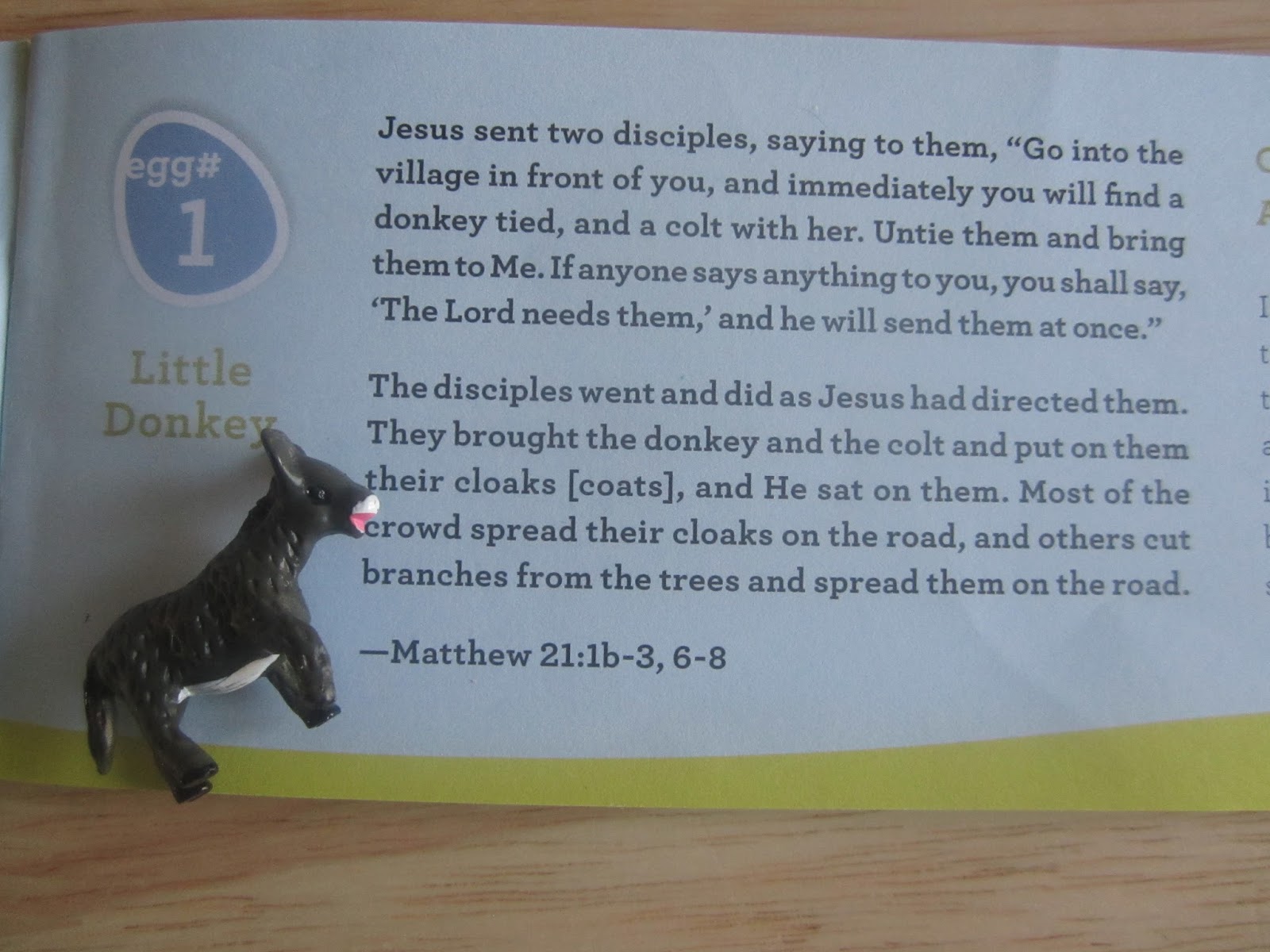
The set includes a plastic egg carton filled with the kinds of eggs we usually fill with candy at Eastertime.  Inside each egg is a token that symbolizes some aspect of the Easter story.  An accompanying book provides Bible verses related to each item, as well as a summary of its significance.  
An example from the Family Life resurrection egg booklet
Once we had read through the narrative a few times, the girls were able to tell the significance of each item without referencing the booklet, and that knowledge has held up from year to year now that we have used the Resurrection eggs for a several Easters now. 

I read some reviews on Amazon for this particular set, and most people responded favorably to the teaching tool.  A couple people pointed out that the booklet is written from a Protestant rather than a Catholic perspective, though, because it says that the Passover wine was a symbol of Jesus’ blood rather than his actual blood.  Also, one person had a problem with the fact that so many of the items in the eggs focus on the violence done to Jesus—a whip, a crown of thorns, nails for the cross, and a spear.  We know our own children best, and will know if they are emotionally equipped to handle the details of the story.  I have found that my girls accepted the details of the story much more readily than I might have expected, and, of course, knowing the extent of the cruelties Jesus endured for us makes his sacrifice on our behalf all the more precious.

The egg set is very affordable, since it costs less than $15 and holds up from year to year.  But you could also make your own set, either for your child or with his or her help.  It might even make the eggs more meaningful if you are using them with older children for the first time.  

Most of the items are extremely simple to come up with; others take just a bit more imagination.  Here are some suggestions if you want to try to make your own set.  Some of the items I’ve included here would need to be replaced year to year, since they are not made of durable plastic.
Egg #1: You could include a small donkey if you can find one among your child’s toys, or use a blade of grass or a small leaf to represent the palm leaves waved by the people when Jesus rode into Jerusalem.  Jesus was greeted by many people like a new king who would save them. 
Egg #2: You could include three dimes.  Some people hated Jesus so much that they wanted to kill him.  They were afraid that they would lose power if people followed Jesus instead of them.  Some of these people paid a man named Judas Iscariot 30 silver coins to help them catch and arrest Jesus. 
Egg #3: You could include a small cup if you can find one among your child’s toys or game pieces, or use a small piece of cracker or bread.  Before he died, Jesus had a special dinner called Passover with his closest friends, called disciples.  During the meal, he told them to remember Him whenever they drank a cup of wine and ate together from a load of bread.  We remember this meal when we take Communion at church. 
Egg #4: You could include a small fabric flower, sold in craft stores.  After the meal, Jesus took his friends with him into a garden to pray.  He knew he was about to die. 
Egg #5: You could include a small piece of leather, brown shoelace, or rope.  In the garden, the people who wanted to kill Jesus came to arrest him.  They took him to their ruler Pilate, who ordered that Jesus be whipped, even though he hadn’t done anything wrong. 
Egg #6: You could include a small piece of thorny rose stem.  After he was whipped, Jesus was forced to wear a crown made out of thorny branches that cut into his head.  Even though he hadn’t done anything wrong, Jesus went through this punishment for us—so that all people past and present—could be forgiven for their sins. 
Egg #7: You could include a nail or a cross charm, as from a necklace. Jesus was forced to carry a heavy cross to the top of a hill, and then he was nailed to that cross to die.  Jesus was powerful enough to stop all this from happening, but he chose not to so that he could receive punishment in our place.  Jesus loves us so much that he was willing to die in our place so we can live with him in heaven forever.

Egg #8:  You could include a die from a game.  Dice are used to play some games.  As Jesus hung on the cross, the soldiers who put him there played a game to decide who could keep his clothing.  Even though this was a cruel game, Jesus prayed to God that these men would be forgiven, too. (See Luke 23:34).

Egg #9: You could use a small spear that is a kid’s toy, or a toothpick or the end of a wooden skewer. Once Jesus had died on the cross, the soldiers stabbed him in the side with a spear to be sure he was really dead.
Egg #10: You could include a small square of cloth.  A man named Joseph asked if he could bury Jesus once he had died and been taken down from the cross.  Joseph wrapped Jesus’ body in cloth and buried him in a tomb cut from rock, like a cave.

Egg #11: You could include a rock or stone.  A huge stone was rolled in front of the tomb’s entrance to make sure no one could come in and get Jesus’ body.  Soldiers sat by the entrance to guard it.  When an angel showed up at the tomb, the soldiers were so afraid that they fainted, and the angel rolled the stone away from the tomb. 
Egg #12:  Leave this egg empty!  When two of the women who followed Jesus came to visit his tomb, they found the stone rolled away, and the tomb was empty.  Jesus’ body was no longer there!  The angel told them, “He has risen!” Jesus wasn’t dead anymore.  Jesus had told his friends that he would die, but then he would come back to life after three days.  He kept his promise!  Because he came back to life, we can live on after our deaths with him in Heaven. 
With smaller children, you might want to try a modified version of the Resurrection eggs, with just six eggs.  You can choose any of the six you would like, but to get to the heart of the Crucifixion and Resurrection narrative, I would suggest using #1, 2, 4, 7, 11, 12.

I based these suggestions on the set of eggs I purchased from Family Life, but if you do an online search for “how to make your own resurrection eggs,” you will find some great ideas.  I especially like the homemade set found at PlayEat Grow and Creative Bible Study.

I keep our set of Resurrection eggs in the bin of spring and Easter decorations in our basement, and bring them out on Palm Sunday each year.  They can be created and used any time of the year, though, because the story of Jesus’ life, death, and resurrection—the Gospel story—is the foundation of the Christian faith, and worth telling every day of the year!

Wishing you and your family a blessed Holy Week, as we remember Jesus’ tremendous gift of death to sin and life in Him!                                                                                                                                                

Tuesday, March 15, 2016

Lenten Devotion: Grace Wins Every Time!

Each year, Media Presbyterian Church in Media, PA, publishes a book of Daily Devotions for Lent.  This year I had the honor of providing a devotion for March 16, 2016, based on Psalm 20.  I am providing the body of the devotion here.  You can find the entire book of devotions by following this link:  Devotionals at MPC.

******************************************************
Source
Please read Psalm 20.

Devotion:  Whether using brute strength to protect his sheep from a lion, or casting a stone from a slingshot to fell a nine-foot Philistine, or commanding armies to overcome enemy soldiers in the battlefield, David always seems to remember where his successes are coming from:

“Some trust in chariots and some in horses,
But we trust in the name of the Lord” (Psalm 20:7).

We know from the accounts in 1 and 2 Samuel that David’s life was neither uniformly easy nor guiltless; he faced lifelong physical, moral, relational, and spiritual struggles, the same as we do. The Psalms record the same gamut of emotional responses that we experience.  But David always comes back to an understanding that God is in control, that God has the victory, and that God has the power and authority to protect and deliver him.

No matter how smart we are, no matter how quick or wise or confident or wealthy or fierce or honored or fit or “together,” our ultimate source of security in this world comes not from our own resources, but from God.  May we, like David, seek the Lord during our times of crisis, with confidence that He is listening in love.

I read once that our lives give us the raw materials for our prayers. We can take all the good and bad, the joys and crises, the questions and dilemmas, the certainties and doubts—everything that is in us, we can take to God in prayer, and trust Him to protect and deliver us. Our circumstances may change, but God’s love for us and His beneficent power over our lives never does. I always come back to Jeremiah 29:11: “’For I know the plans I have for you,’ declares the Lord, ‘plans to prosper you and not to harm you, plans to give you hope and a future.’”

We serve a merciful God, and in the words of Christian singer Matthew West, “I’m living proof that grace wins every time”!

Please pray with me:  Almighty God, no matter what challenge, crisis, or hardship arises, help us to realize that our own strength and resources will never be enough to see it through. Help us always to turn to You , Lord, as the source of our strength, courage, comfort, and victory.
Source

Thursday, February 11, 2016

Art-Making as a Spiritual Practice

Two of my mother's art journals
The editor of Everyday Spiritual Practice, Scott W. Alexander, defines an everyday spiritual practice as “any activity or attitude in which you can regularly and intentionally engage, and which significantly deepens the quality of your relationship with the miracle of life both within and beyond you” (5).  When our activity is intentional, regular, and deep, when we are committed to making it a recurring and significant part of our lives, then, Alexander writes, it achieves the level of “spiritual practice.” 

In this same book, Julie-Ann Silberman writes of her artwork as her daily spiritual practice.  “My goal,” she says, “is not to create masterpieces, but to get more closely in touch with my interior spiritual life” (255). 

Silberman describes how her art practice developed out of a need to grieve over her father’s death beyond words she could speak to her friends; she had images in her mind that better reflected her emotions.  She developed her practice out of chalk and oil pastels on canvas.

In a similar way, my mother, Anne Landrum, developed a spiritual practice of art journaling while serving as the primary care-giver for her husband for three years after he experienced a massive stroke in 2010.  Her “art language” was collage, which she found more accessible than drawing, and helped her to realize, “I could illustrate things I couldn’t put into words.”
For example, several of her journal pages reflect her experiences of an intense lack of sleep, as she was on-call for her bed-bound husband’s needs through the night.  She created one page filled with images of people sleeping, and for her, it expressed her intense desire for sleep without sounding like she was complaining. 
Her pages allowed her to celebrate the good days, and calmed her down on the rough ones.  Since she was spending so much time in her house anyway, without as much housework and cooking to attend to anymore, she found that her journaling offered her quality quiet-time.
“I didn’t have to think about the outcome,” she explained.  “The jumbled pictures matched my jumbled mind, and when I cut pictures, they didn’t have to make sense.”
Alexander points out in his introduction that our spiritual practices may shift and change over the years according to our circumstances (6), and that has been the case for my mother.  Two years after her husband’s death, my mother has moved to a new state to live near one of her daughters and two of her grandchildren, and she has the freedom to visit her other daughter and grandchildren now that she is not so tied to home because of care-giving. 
Now, when she sits down to create art journal pages, she says the process feels more “forced”:  “I feel there’s nothing I can put on the paper that’s going to make me feel any better than I already do.” She feels as though her pages no longer tell a story about herself, and that with no more “angst” to release, she can “come up with stuff and make it pretty,” but the practice doesn’t talk to her anymore.

Cutting out various images from magazines and decorative papers allowed my mother to create pages that brought about order from chaos—with the symbolic act on the page helping her escape the powerlessness to do so in her real life.  “Now, there’s no chaos,” she says.  “I don’t know how to make more order now.”  
If art journaling was a process of coping for her, now she says she has begun a process of learning—especially through reading and Bible study.  She also enjoys the new trend in coloring books for grown-ups.  Where, before, the process of choosing colors for the designs would have driven her crazy, she says, now she enjoys the act of selecting colors and staying within the lines.  “It’s a different thing, because I’m in a different mood.”
When art is used as a spiritual practice, like my mother’s art journal pages, it is not necessarily intended for public display. Our art-making, in its service to our spirit, isn’t about display, sharing, or selling.  This makes more sense when we equate art-making with practices like prayer or scripture study.  The value in these practices is found in the doing, and as Silberman points out, no one expects us to share these disciplines in a public way (258).  When people find out we make art, they may want to see it, and may wonder why we “bother” to do it if we aren’t planning to show it or to sell it.

I faced that attitude from my own self: did it make sense to purchase so many art materials and dedicate a whole room to my projects if it wasn’t going to bring some practical result: income? publication? some way in which other people have the opportunity to validate my work?  

Silberman reminds us of a truth we may have to spend some time convincing ourselves of: “Creativity is about the process, not the outcome, especially when it is being used as a spiritual discipline.  Creativity is about the experience, the identifying and releasing of feelings and core responses to the world around us” (258). Whether we want the world to be privy to those feelings and responses is a question we can consider later, when we can determine if we are resilient enough to continue with our practice no matter how other may respond to it.

Each person who desires to pursue art-making as a spiritual practice has a wide variety of materials and approaches to choose from.  Through personal interests and trial and error, each individual can consider what will most effectively fulfill his or her spiritual goals:

Watercolor
Acrylic
Oil
Paper
Canvas
Found materials
Assemblage
Digital art
Mosaic
Marker
Spray paint
Art journaling
Collage
Fabric
Ceramics
Stitching
Gluing
Hardware
Photography
Encaustic
Pastels
Pencil
Mosaic
Drawing

As people made in the image of God, we are creative beings; we carry some element of God’s creative power within us.  Engaging in art as a spiritual practice is a path to getting back in touch with this personal characteristic that has been with us all along; it’s just been misplaced in the shuffle of life, perhaps buried under different concerns.

How might you explore the possibilities of art-making as a spiritual practice this year?

 **********************************************
Many thanks to my mother, Anne Landrum, for opening her personal journals to me, and allowing me to share images from them with you, my blog readers.

Thursday, January 21, 2016

Faith Accompanied by Action: Winter Blanket Mission

What good is it, my brothers, if someone says he has faith but does not have works? Can that faith save him? If a brother or sister is poorly clothed and lacking in daily food, and one of you says to them, "Go in peace, be warmed and filled," without giving them the things needed for the body, what good is that? So also faith by itself, if it does not have works, is dead" (James 2:14-17).
The Living Stones Women's Ministry collected blankets to donate to the Media Food Bank Clothing Closet during the months of November and December.  I was happy to get them dropped off this morning, just in time for the freezing, and possibly very snowy, weather we will be experiencing this weekend in the Philadelphia area.

In addition to the nine blankets my mother and I donated back in November, the women of Living Stones provided eleven additional blankets for me to take in this morning!
We received a number of new and gently-used blankets, but I have to give a special shout-out to Stephanie, who provided four hand-tied fleece blankets in the most wonderful fabrics.
I loved these two designs so much, I had to take a special photo of each to remember them:
When I left the blankets at the Clothing Closet this morning, the woman who took them from me said that she would distribute them to the people who came this evening.  I know that it can sometimes feel impossible to be effective in the face of the unspeakable need in our world.  But just imagining eleven children wrapped in these blankets this weekend--children who would not have them if the women of Living Stones had not taken the time and made the effort to purchase, choose, or create them--makes me realize how seemingly small actions can make an incredible difference in people's lives.

Please consider some small act that you can do in the coming week that could make a difference in the life of someone in need.  Glory to God for faith accompanied by action!

Sunday, January 17, 2016

Word for the Year: Our First Meet-Up

When I posted about finding my Word for the Year at the beginning of January, a few friends from church commented on Facebook that they, too, choose words to direct their years.  A group of us thought it might be fun to remind each other to reflect on our words over the course of the year, kind of holding ourselves accountable to the vision we were creating for 2016.

After I put out some feelers to a larger group of women, we ended up with 20 people interested in finding, exploring, and sticking with a meaningful word for the year!

Our plan is to meet four times over the course of 2016, while also communicating monthly via email.  We will complete prompts and projects to keep us thinking about our words, and we will reflect on how "living" our words is affecting our lives in positive ways.

On Saturday morning, we had our first "official" Word for the Year meet-up, with eight women gathering at Media Presbyterian Church for several hours of fellowship, conversation, and activities surrounding our chosen words.

At our meet-up, I shared some of the ideas and information I had gathered from Ali Edwards' One Little Word site, which is a great place to begin if you are interested in finding out more about how choosing a Word for the Year can be a productive exercise.

Ali explains that the word we choose basically sums up what we want for ourselves over the course of the year; it represents what we want to invite into our lives.  She specifies that we choose words that have meaning for us, and resist any temptation to choose words we think someone else might pressure us to select.  Ali also emphasizes that there is no "perfect word," but rather "choices and paths and possibilities."
At our meet-up on Saturday morning, we all shared the word we had selected, or the one that seemed to be pulling at us most insistently.  We spent some time individually considering our words:  what it means to us, some synonyms for it, how our lives already embody the concept, as well as how we would like our lives to embody it more fully.  We also brainstormed ways to stay connected with our words over the course of the year; we will explore some of these ideas as part of our group activities, while others we may pursue individually if they sound interesting to us.  (We had ideas that ranged from collages and journals, to screen savers and iPhone reminders, to texts from friends and lipstick on the mirror!)

For the rest of our meet-up, we engaged in activities that will help us stay connected with our words this year.  First, we made old-school collages, using scissors, glue sticks, and a huge pile of magazines that participants brought along with them that morning.

Our collages included words and images that appealed to us and related to our selected words, though we had no obligation to justify or explain why we included them.  If we wanted something on our collage, we added it!

My love for cutting up paper is well-documented on my Drawing Near blog, so I was happy to share this relaxing and therapeutic pastie with my Word for the Year friends.

As we worked, we each got our photo taken holding a sign with our word written large.  Participants are encouraged to keep both their collages and their photos someplace meaningful for them:  posted on an inspiration board, on the fridge, on a cabinet door or a mirror, in a drawer they can open for a quick peek, or in a notebook.
I am creating a small-sized binder for all of my Word for the Year materials.  I discovered that if I cut my computer-paper-sized collage in half, it fit perfectly inside.
We also talked about keeping a journal or monthly record over the course of the year.  Some form of written record will allow us to document our activities, experiences, thoughts, and feelings related to our words.  Even if we write just one entry a month, we will have a solid record of twelve entries by the end of the year.  Some may use words, others may rely on images, while others may include both.  We can write about our experiences as bullet-ed lists or items on a chart, or we can write in a narrative manner, if that comes more naturally.  We will be able to share from our monthly records when we have meet-ups later in 2016.
Finally, we each got an email partner.  We are committing ourselves to send at least one message each month--saying hello, asking how our Word for the Year experiment is progressing, sharing an inspiring quotation or a funny joke.  It's just one more way to keep ourselves connected with our word and with this project over the course of the year.
We got off to a great start at our Saturday morning meet-up, and some of us even stayed an extra hour-and-a-half, determined to finish our collages before we went home!  I will continue to share our journey here on the blog, and I invite you to come along and see where our Word for the Year adventure takes us!

Friday, January 8, 2016

What Does the Bible Teach Us About...?: New Year's Resolutions

Source
How does God feel about all the resolution-making, plan-laying, and goal-setting that go on every New Year?

Perhaps the answer seems obvious to you, but I wasn’t so sure.  Does a lot of intense personal goal-setting suggest a lack of confidence and faith in Him to direct our lives? Or does sitting back and waiting for Him to work His Will for our lives represent a misuse of our gifts?

Before I launched into another year of resolution-chasing, I decided to do what I had never done before, and look at what the Bible has to say.

When I look at God as He reveals Himself to me in the Bible, I see a Planner.
When God undertook the astounding task of creating the heavens and the earth (Genesis 1:1), He made progress each day toward His ultimate goal, and even left Himself an opportunity for rest once the task was completed (Genesis 2:2).

When, in spite of eternal life, blissful paradise, and daily face-to-face communion with God, Adam and Eve misused their circumstances to try to attain wisdom equal to their Creator, God already had a plan in place for the redemption of humankind when He uttered these words to the serpent: “I will put enmity between you and the woman, and between your offspring and hers; he will crush your head…” (Genesis 3: 15).

When the Israelites were making their way toward the Promised Land, God planned for ways to guide them (as a pillar of cloud and fire), and to feed them (with quail and manna), and to make the promised lands available for them (in the defeat of the people who were living there).
Unknown Source (broken web link)
Rick Warren points to Ephesians 1:10, in which God’s plan is revealed to “bring unity to all things in heaven and on earth under Christ,” to demonstrate that God Himself sets goals, in addition to making plans.  “God has goals for history that have nothappened yet,” Warren writes. “God has goals for his family—the church—thathave not happened yet. God has goals for your life that have not happened yet.”

If God Himself sets goals and makes plans, then I think we can feel comfortable moving forward with New Year goal-setting.

When I look at the people of God in the Bible, similarly, I see planners.
I see Jesus setting out a detailed plan for his disciples when he sends them out to teach and heal on their own for the first time (see Matthew 10:5-15).  He also seems to understand his Father’s plan for his life and death as he makes his way towards Jerusalem and predicts his death to his disciples (see Matthew 16:21). He has very specific plans in place for his final Passover meal with his closest friends (see Matthew 26: 17-19).
Source
I see Jesus’ disciples making plans for how to provide for themselves as a new kind of religious community; they shared all possessions in common, and by doing what was necessary to support themselves, they ensured that there were no needy people among them as they testified to the resurrection of the Lord Jesus (see Acts 4: 32-35).  

Further, when it became necessary, they developed a plan so that some leaders could focus on providing for followers’ physical needs, while other leaders continued to focus on the ministry of the word of God (see Acts 6: 1-6).

I see Paul making travel plans to spread the good news of Jesus Christ, as well as plans to revisit the churches once he has planted them (see Acts 15: 36, for example).  Sometimes his plans were thwarted, because of earthly circumstances (see Romans 1:13) or divine intervention (see Acts 16: 6-7), but that did not keep Paul from “press[ing] on toward the goal to win the prize for which God has called me heavenward in Christ Jesus” (Philippians 3: 14) in the best way he understood.

If Jesus and his followers set goals and made plans, then I think we can feel comfortable moving forward with New Year goal-setting.

When I look at Jesus’ teaching in the Gospels, I see instruction related to setting goals and making plans.
In Luke 14, Jesus uses two different examples to show that his disciples need to count the cost of choosing to follow him, rather than making the choice rashly and without serious consideration.  In verses 28-30, he points out that anyone planning to build a tower would sit down and estimate the cost of the project to be sure he has enough money to complete it, rather than laying the foundation and then running out of money to finish.

In verses 31-32, he points out that a king planning to go to war against another king would sit down and figure out if he has any chance of winning based on how many men he has to fight with compared to his opponent.  If he determines that he has no chance with his smaller numbers, then he will send a delegation asking for terms of peace, instead. 

If this type of worldly goal-setting and plan-devising is advisable, Jesus is basically saying, how much more so should we be basing our decision to follow him on a well-considered understanding of our true commitment to being his disciples. 
Source
These examples make me think of Jesus’ parable of the wise and foolish builders, recorded in Matthew 7:24-27.  In this parable, he is saying that someone who hears Jesus’ teachings and puts them into practice is like a man who builds his house on solid rock, which can withstand the rigors of the wind and rain, while someone who hears his teaching and does NOT put them into practice is like a man who builds his house on the shifting sands that cannot withstand the eventualities of nature. 
Because Jesus’ parables used the truths of nature to lead his listeners to understand spiritual truths, I am led to believe that good planning, and the goals made attainable through that good planning, is a practical necessity that he embraces for our natural lives. 

With God as our solid foundation, as we “seek first His kingdom and His righteousness” (Matthew 6:33), we set our goals; we work towards our goals; and God brings about His great purposes through us.

God cares about our eternal destination, but I believe He cares about our day-to-day decisions, as well.  Because we are His children, I believe our goals, our plans, and our choices matter to God.   As blogger Kristen, from Celebrate Every Day With Me, writes, the Bible verses we read about making plans and setting goals “aren’t just for salvation.  They are for how we live now, too.  Are we committing our ways to Him? Are we thinking on godly things? Are we persevering? Are we seeking Him? What is the attitude of our heart?”

*******************************************************

There has been so much enthusiasm at my church around the Word for the Year concept.  We are getting a group together to meet periodically through the year, and stay in touch via email so that we can use our chosen words to help us focus on our goals for 2016.  Here are a few resources you might check out if you would like to pursue your own Word for the Year program:

I will also share with you on this blog the progress that our women's group at church makes during our local effort to commit to a Word for the Year!

Source
Related Posts Plugin for WordPress, Blogger...