Sunday, November 15, 2015

Putting Our Faith to Work: Winter Blanket Mission

The other night as I was putting my daughter Katy to bed, I noticed that it was chilly in her bedroom, and commented that we should put another blanket on her bed to snuggle with on these colder nights.  She chose one from the stack at the top of her closet, and cozied down for a good night’s sleep.

I thank God every night for our comfortable, warm home, and I pray that others are blessed with the same safety and warmth we enjoy.  But as I well know from the Book of James, it’s not enough just to pray for it and wish others well:
“My brothers and sisters, what good is it if people claim they have faith but don’t act like it? Can that kind of faith save them? Suppose a brother or sister has no clothes or food.  Suppose one of you says to them, “Go, I hope everything turns out fine for you.  Keep warm. Eat well” and you do nothing about what they really need.  Then what good have you done?” (James 2:14-16, NIrV)
This passage from James challenges us to “put our money where our mouth is,” so to speak, to match our actions to our words. 

Our actions bring life and usefulness to our faith (James 2:17, 20).

At the beginning of this year, I decided that I wanted to get back to crocheting, but I didn’t have anyone to make blankets for.  (Granny-stitch blankets are pretty much the extent of my crocheting repertoire.) 

I had a sudden thought one night as I drifted off to sleep that I would crochet blankets, and then donate them to the Media Food Bank’s clothing donation room.  I had helped out there last winter, and they were trying to make sure that everyone who came received a hat and a pair of gloves for the frigid temperatures we were experiencing.  I thought it would be great to contribute toward a goal of the babies and children whose parents go there to receive a blanket to stay warm this winter.

My mother decided to join me with this project.
By last week, we had nine blankets and four hats between us to contribute to the Media Food Bank! 
All of her blankets and hats were crocheted, while mine were a mix of crocheting and no-sew fleece projects. These are not blankets for covering a bed, but rather blankets to wrap a baby or child up in for a warm sleep. 
I also included two little "schleppies"--small 10"x10" fleece blankets with fringes for babies to play with (like the "taggie" blankets that were so popular when my girls were babies).  
I also made a couple of no-sew fleece hats from a pattern I found in a library book ages ago.
I would like to invite you—challenge you!—to join me in contributing a blanket to the Media Food Bank so that even more babies and children will be warmed this winter.  I heard a song not long ago that included a man wondering why God didn’t DO something to help out with all the need he saw in the world, and God answers back, “I DID do something:  I created YOU.”  Join me in being part of God’s answer to the need in our corner of the world. 

Here are some ways you can get involved this holiday season:

1. Crochet or knit a child-sized blanket.
2. Buy a no-sew fleece blanket kit from the craft store to create a cozy blanket with tied-fringe edges. Don't forget to take a coupon with you in case they aren't already on sale!

3. Buy 2 yards of solid color fleece and 2 yards of patterned fleece, then watch a YouTube video to find out how you can make a no-sew fleece blanket in just a couple of hours.
4.  Purchase a $5 fleece throw blanket at Five Below.

5.  Purchase a $15 to $30 blanket at Target; there are plenty of differently-priced options to choose from.

Once you have your blanket donation, you can give it to me and I will deliver them all at once to the Media Food Bank as a ministry donation of the Living Stones Women’s Ministry, or you can deliver your blanket donation on your own to 350 West State Street, Media, PA, at the First United Methodist Church. 
A clothing closet volunteer finds a spot for our blankets.
If you are not a member of Living Stones and do not live in this area, please consider a blanket donation to a Food Bank/Homeless Shelter/Clothing Closet near your home.
However you choose to participate, please contribute by New Year’s Eve Day 2015! 

There are 17 women currently on the email list for Living Stones.  That is 17 warmer babies and children if we each just contribute a single blanket to the cause!  If others outside of our group get involved, the needs of even more families will be met in this basic way.

Thank you for your participation!

Sunday, November 8, 2015

Pick Up Your Mat and Walk!

If you had asked me at the beginning of last week, “What did it take to be healed by Jesus?” I would have answered, “Jesus healed people who showed that they had faith that he could.”

After all…

When the bleeding woman touches the hem of Jesus’ robe, she thinks just that distant connection is enough, and Jesus says that her faith heals her.  When the four friends lower the paralytic through the ceiling of the home where Jesus is preaching, He sees their great faith, and their friend is healed.  When the synagogue leader demonstrates faith that his daughter can be brought to life, even though the mourners at the house laugh at the suggestion, the little girl rises up to have something to eat. 

The presence of faith in so many gospel accounts brings about mighty miracles.

But during Bible study last Thursday, as we talked about the healing of the man at the pool recorded in John 5:1-18, I learned something new about Jesus’ healing miracles, which also taught me a lot about God’s grace.
image from matt-lifeinthespirit.blogspot.com
************************************************************
Note:  I want to thank my Associate Pastor Nikki Passante for her teachings about 
this Bible passage during our Bible study last Thursday.  
Many of her insights are included in the post.
************************************************************

In this gospel episode, Jesus is in Jerusalem for a Jewish festival, and goes by a pool of water in an area of the temple known as the Sheep Gate.  At this pool, a “great number of disabled people used to lie—the blind, the lame, the paralyzed” (verse 3).  They embraced a popular superstition that an angel of the Lord would periodically stir up the waters in the pool, and that the first person to get into the pool when the waters began to move would be healed of his disease or condition. 

On this particular day, Jesus encounters a man called “an invalid for thirty-eight years” (verse 5).  We don’t know how long he has been lying there next to the pool, but we know that it is long enough to feel hopeless that he’ll ever have a chance to get healed; after all, when the waters stir, he has no one to carry him to the pool, and he can’t move to it on his own (verse 7).  Someone must have brought him here, but it sounds as though no one has been there to care about his plight for quite some time.  Where is his family?  Where are his friends?  He has likely gone unnoticed for quite awhile. 

But Jesus sees him, and Jesus recognizes his need.

“Do you want to be well?” Jesus asks the man (verse 6).

 “Do you want to be well?” This is what you’re going to ask him, Jesus?  Don’t you assume he wants to be well after thirty-eight years of suffering? Don’t you know he’s miserable—alone, neglected by friends and family, unable to make it to the water’s edge in time for healing, watching everyone else get their miracle while he continues in his distress?

BUT:

Imagine how painful a healing after thirty-eight years could be. 

This man’s invalid state has become central to his identity; it is likely central to how he sees himself and how others relate to him, if at all.  His condition has become a way of life. 

A healing would require the building of an entirely new life.  He’s going to have to figure out how to earn a living, how to interact with his community, how to regain an identity within the temple.  It’s not going to be easy. 

Put in those terms, it might be easier to go back and sit by the pool!

We don’t ever really find out the man’s answer to Jesus’ question.  Does he want to be well?

His response is much more complicated than a “yes” or a “no.”

There are probably a number of ways to read the man’s tone in verse 7, when he says to Jesus, “Sir, I have no one to help me into the pool when the water is stirred.  While I am trying to get in, someone else goes down ahead of me.”  I tend to read it with a kind of whining tone:  Everyone always gets in ahead of me!  When will it be my turn?! 

But at the same time, I can also imagine the genuine despair he must feel at losing again and again what he sees as his chance for healing. 

Perhaps this man is “playing the victim,” or perhaps he is simply expressing, “I want to get well, but I can’t do it on my own.”  Either way, he is being “real” with Jesus.  Whether he bears bitterness, a victim mentality, abject misery, hopelessness, or some degree of all of these, he exposes his heart to Jesus no matter what it looks like. 

And no matter what it looks like, it’s okay with Jesus.  Jesus has sought him out, Jesus has taken the initiative to approach him, Jesus demonstrates His divine grace and heals him.

God’s grace is truly a free gift, not dependent on the state of our heart.

This man, by the way, didn’t even know he was talking to Jesus (verse 13)!  It is not his faith that saves him; no specific belief is required for his cure. 

Jesus is not limited by our faith or lack of faith.

God’s grace is truly a free gift, not dependent on the state of our own faith.

Jesus gives this man what he never even asks for. 

This miracle calls to my mind the miracle at Cana, where He changes water into wine at the wedding feast.  Mary, remember, points out to Jesus that the host has run out of wine, but doesn’t dictate a specific action for Jesus to perform; rather she simply directs the servants to do whatever Jesus tells them to do (John 2:5).  Rather than simply calling up a few extra glasses to provide for the most important and potentially influential and critical guests, Jesus provides six large stone jugs full of top-quality wine to carry through the rest of the feast (John 2: 6-10). 

Likewise, by the pool, Jesus does more for the man that he could have ever thought to ask.  If anything, perhaps he might ask Jesus to help him to the pool’s edge in time for the stirring of the waters.  Never in his wildest imagination would he have said, “Please heal me so I can walk again.”
And yet that is just what Jesus does for him:  “Get up!” He tells the man. “Pick up your mat and walk.” 

This time the man does not delay with stories and excuses, as in verse 7.  Rather, he is cured at once, and so picks up his mat and walks.

Jesus’ compassion surpasses all limits—the limits of what we can imagine to ask for, the limits of human law codes or social expectations.  He doesn’t take a day off from caring about people, or relating to people, or demonstrating compassion, or doing His Father’s work. 

God’s grace is truly a free gift, not dependent on what we think to ask for.

I love that when Jesus goes to look for the man after his healing, He finds him in the Temple.  It’s a promising start to the man’s “new life.” This man seems to know that something extraordinary has happened, something that warrants some praise and thanksgiving to God. 

But that doesn’t stop Jesus from issuing a further warning:  “See, you are well again.  Stop sinning or something worse may happen to you” (verse 14). Again and again in the gospels, there seems to be a close link between a person’s physical healing and their spiritual healing, a correlation between healing and forgiveness.  Here, Jesus seems to be saying, Now that you have bodily health, attend to your spiritual health.  The consequences of neglecting your spiritual health would be even more dire than the misery of the physical distress and suffering with which you are well familiar.

As a result, this man becomes a witness to Jesus the Healer.  “The man went away and told the Jews that it was Jesus who made him well” (verse 15).  I don’t think he did this with evil intentions; I don’t believe he knew that the very men he told of his experience were the ones who wanted to see Jesus dead.

God’s grace is truly a free gift, a gift that heals us, fills us, changes us, revives us.

Thanks be to God, He never leaves us where He finds us!  He bids us pick up our mat and walk.

************************************************************

As an aside, I was struck during Bible study by what a great bumper sticker we could create based on this account from the gospel of John:

Pick Up Your Mat and Walk!

Don’t dwell in your weakness.  Walk in the forgiveness and healing that God has given you as a free gift.  Live in that state of grace that God offers to you in Jesus Christ. 

Pick Up Your Mat and Walk!
Source


Monday, November 2, 2015

Living the Questions with Rachel Held Evans

Source
What happens when a Christian woman questions one area of her faith, or doubts one aspect of what she has always been taught to believe?

It’s a slippery slope, isn’t it?  One question leads to another, one doubt brings to mind others, and she is suddenly in danger of her whole belief system coming unraveled.

Rachel Held Evans recently posed this scenario—drawn from her own Christian walk—at a talk given to students at Eastern University entitled, “Living the Questions.” How we understand our faith and how we explain it to other people changes with the seasons of our lives, Rachel told us.
Rachel Held Evans, speaking at Eastern University in October 2015
But for a long time, she didn’t know those kinds of changes were allowed.

For Rachel, the questions began in her years at a Christian middle school.  She was always taught that anyone not coming to God through a belief in salvation through Jesus Christ was going to hell. 

And then for English class, she read The Diary of Anne Frank

She was so moved by this young girl’s story, and could not imagine that the God of her faith was going to treat Anne even more horrifically than the way she was treated during the Holocaust. 

The questions resurfaced in her years at a Christian university, where she was told that all Muslims were going to hell. 

At one point on the news, however, she saw footage of the stadium execution of a Muslim woman charged with adultery.  And again, moved by her story, Rachel could not imagine God subjecting this woman to an even greater punishment than she faced under the horrors of the Taliban, simply because she was born into and raised in the Muslim faith.

Rachel could no longer shove down the questions, could no longer hold so tightly to the faith she had been delivered as a child.  In spite of the “Best Christian Attitude Award” she won for three years in a row as a young girl, Rachel came to see doubt as better than its alternative—a Zombie-faith, as she calls it, a checked-out faith, an ongoing fear that her faith wasn’t strong enough to handle tough questions.

In Rachel’s mind, it’s 100% worth it to risk that slippery slope, in order to live with a tried and tested faith.  She proudly calls herself a “doubt-filled believer.” As she told us in her message, “If there was a guarantee, then it wouldn’t be faith.  That’s part of the deal.”

For Rachel, she indeed found herself on that dreaded slippery slope, but for her, it led right to Jesus.  She vows to keep her head and heart fully engaged in her faith, and to do that, she told us that she made friends with her doubt; her doubt has actually become a part of her faith.

She characterized a dangerous doubt as being the kind of doubt that would lead us to stop obeying—to stop doing the things that Jesus teaches us to do, such as caring for others and praying for our enemies. 
Rachel, far right, listening to the introduction to her talk
Faith isn’t about getting everything right and having perfect doctrine, Rachel says.  Faith is about following Jesus in spite of our doubts.  She spoke of the importance of routine for preserving her faith.  She prays, she goes to church, she continues in these practices of her faith, even when she is going through a particularly intense period of questioning or doubting. 

Hearing Rachel's talk made me consider the role of doubt and questioning in my own faith journey. 

We can easily move through life in a state of doubt if that is our personal disposition.  We can doubt that the actions of the people around us are done with positive intentions.  We can doubt that our efforts to serve in our communities will make any real difference.  We can doubt that our efforts to be good role models to the young people around us will influence them in any way.  

For me, doubt is a negative state of mind that would leave me pretty miserable day-to-day if that was the way I chose to live my life.  

If I choose to go through life doubting that God exists, doubting that God really cares about me, doubting that God hears my prayers or that my prayers make any real difference, then I can pretty well guarantee that my faith will not just unravel, but that my whole spirit will shrivel away in exhaustion and distress.

I have a very different view of questioning, however.  

For me, questions are the driving force behind learning, behind increasing my knowledge and deepening my understanding of any topic or person.  If I re-frame my doubts as questions, then I am on a life-giving, faith-strengthening path:  Where do I see God at work in my life and my world today, helping to support my faith in His existence and His concern for me?  How can I strengthen my prayer life and engage in daily communication with God?  How can I listen for God’s “voice” in my life, perceiving the ways He communicates right back to me?  

If I choose to go through life asking questions about my faith journey and my religious traditions, then I can pretty well guarantee that my faith will not just hold together, but that my whole spirit will strengthen and flourish. 
Source
God tell us in the Book of Jeremiah, “Call to me and I will answer you, and tell you great and unsearchable things you do not know” (33:3).  And Jesus Himself tells us, “Ask and it will be given to you…” (Matthew 7:7).  James writes to Jewish believers living in Gentile communities outside of Palestine:  “If any of you lacks wisdom, you should ask God, who gives generously to all without finding fault, and it will be given to you” (1:5).  God’s Word supports a questioning Christian, one who calls out to God, one who asks for wisdom, and one who remains open to the “great and unsearchable things” that God would then reveal.

The Psalms are filled with tough questions for God:  Why do You hide in times of trouble (10:1)? How long, Lord? Will you forget me forever (13:1)? How can we sing the songs of the Lord while in a foreign land (137: 4)?  David is always described as “a man after God’s own heart,” and he felt free to cry out to God with whatever deep and honest emotion he was experiencing, even the hard questions that we continue to ask so many thousands of years later. 

I have not read Rachel Held Evan’s books yet, so I don’t know the specific nature of the doubts she has faced over the years.  While she calls herself a “doubt-filled believer,” she speaks of never knowing when she’ll head to church on a Sunday and not believe a word of what she hears.  She talks of conversations with her husband about whether they will raise their son (due early next year) as a Christian.  She speaks of faith crises that have cost her friendships, until her friends came around to their own faith crises and could finally understand where she was coming from. 

Rachel ended her talk with the admonition to respect each others’ journeys, and I agree wholeheartedly that we all relate to God in beautifully individual ways.  And she seems to have grown in her understanding that she shouldn’t “evangelize the doubts,” trying to spread her faith crises around to her friends.  And finally, even though she has doubts related to the Gospel, she told us that “the story of Jesus is a story I’m willing to risk being wrong about.” 

Faith, she says, is about taking the risk of obedience in spite of the doubts, taking the risk of being wrong about what we are putting our faith in.   

The caution that I would offer is to beware of doubting for the sake of doubting.  Turn your doubts into questions, and bring them to God.  Seek His answers in His word, through the teachings of trusted Christian leaders, in conversation with other seeking believers, and in other resources that God will almost surely place in your path once you bring your questions to Him with an honest and authentic desire for the answers.  
****************************************
What role has doubt and questioning played in your journey of faith?  Did you experience the "slippery slope" phenomenon that Rachel describes, and did it bring you right back to Jesus?  Do you see a difference between doubting and questioning, in the way that I do?  Please join the conversation in the Comments section!
Source

Thursday, October 22, 2015

Deeds of Darkness or Harmless Fun: Looking at Halloween from Christian Perspectives

Source

NOTE:  This began as a very brief blog post about my thoughts on celebrating Halloween.  Then I reached out by email to a community of women within my church, and received additional perspectives on the subject that I wanted to share with you as well.  Many thanks to the women who took the time to share their experiences and perspectives!  Please add your voice to the conversation with a comment.

***************************************

"It's Not Really My Thing"

People celebrate BIG for Halloween where I live.  Halloween rivals Christmas for outdoor home and lawn décor.  We see inflatable ghouls riding motorcycles, spiders crawling up the sides of houses, netted webs across bushes, and phantoms hanging from the trees. 

Every year my girls ask if we can decorate BIG for Halloween, and every year I say, “Nah, Halloween’s not really my thing.” (I’ve always felt that’s close to blasphemy around here, so I usually keep that opinion within the family.)

This year, on the way to taking Bayla to 1st grade and Katy to 2nd grade, we passed a house with a simulated graveyard on the front lawn—a sea of headstones with sentiments like, “I love dead people” and “RIP Zombie.”  The girls asked if we could put a graveyard in our front yard, too.  I tried my usual, “Nah, Halloween’s not really my thing,” but they pressed me to find out why not.  This is what I told them,
“Girls, I don’t think it’s wrong to celebrate Halloween, and I don’t mind the ‘fun side’ of it with pumpkins and candy and that kind of thing.  But Halloween isn’t a Christian holiday.  Halloween celebrates monsters and witches and darkness and scary things, while God is Light and Love.  That’s why I don’t ‘get into’ the scary, dark side of the holiday.”
They set aside their dreams of a front yard cemetery, and Katy moved on quickly to, “Okay, Mommy, but can you get us some white cloth and some thread?; I have an idea for making ghosts…”

I had never before articulated my “problem” with Halloween, so my response to the girls was completely off the cuff, but it set me to thinking about a Christian’s “proper” response to this somewhat controversial holiday. 

The Bible doesn’t directly address Halloween, trick-or-treating, and creepy home décor, so Christians have to decide for themselves from what the Bible does say and their personal direction from the Holy Spirit how they will respond to it. 

Responses to Halloween

Some Christians fully embrace Halloween; as one of my friends wrote to me in an email: “I see Halloween as a fun night to be creative with costumes and have fun with your friends.”  Another friend wrote that until her son began attending a private Christian school, Halloween had always been “an innocent day where kids dress up and get candy.  Friendly pumpkins, fall leaves, candy corn…what’s so bad about that?”

Others celebrate a modified version, with certain limits that make it more comfortable for them. As one  friend shared with me, she and her husband focused on the “community building connections” of trick-or-treating, and encouraged her kids to create clever, rather than gory or dark, costumes.  Their decorations focus on pumpkins, gourds, hay bales, and cornstalks, what she calls “evidence of God’s creativity and goodness” rather than the “scary stuff.”  Another friend agrees that the children are allowed to dress up in “non-ghoulish attire” and “exchange candy with our neighbors as an expression of welcome and friendship with our community.” 

Some ignore it quietly, like a family in Katy’s kindergarten class who kept their son out of school on the day of the class party and costume parade.  A woman from my church described Halloween as having a negative effect on her son’s spirit when he was just three or four years old.  She had not much liked the holiday anyway, so her family stopped celebrating it.  In place of trick-or-treating, her children got to go to the store and pick out their favorite candy, and on party day at school, they could choose to dress up if they chose, or stay home that day if they preferred. 

Others boycott it, perhaps by turning off the lights during trick-or-treating, or leaving them on while refusing to answer the door.  When my friend’s son began attending a private Christian school, they encountered an environment in which Halloween is not even mentioned, except to specify that no Halloween-themed shirts are allowed on “wear your favorite holiday shirt” day. 

Still others turn it into an opportunity for evangelism, perhaps handing out Bible verses attached to their Halloween candy, or speaking about Christ to the children who come to their door. 

Determining Your Comfort Zone

No matter what your “take” on the holiday, I think the important thing is to determine the parameters of your comfort zone, and listen to the calling of God’s spirit on your conscience.  I don’t like monsters, skeletons, devils, skulls, and creepy witches.  I don’t mind pumpkins, cats, “cute” witches, and ghosts of the white-sheet, not-particularly-frightening variety.

I have let my girls participate in school Halloween Trunk-or-Treat events and trick-or-treating around the neighborhood.  They love going around for the candy, and enjoy the experience of handing out candy at our house almost as much.  I have determined that all of this lies within the parameters of my comfort zone.

A woman from my church made a very good point:  She grew up in a home where Halloween was not observed, and was seen as evil.  Because it wasn’t part of her childhood, she “had no sentimental connection or enthusiasm about Halloween; it was a non-issue.”  She had to reevaluate her point of view after marriage to a man who embraced the holiday with enthusiasm.  But she continues to welcome conversations on topics like these, saying, “I find compelling arguments for many perspectives and am not married to mine should the Lord convict my heart in another direction.”

In addition to listening to your own conscience by defining the parameters of your comfort zone, and being open to redefining your views, consider this point from this same friend:  Consider consistency.  “Am I making an issue out of something I’m okay with in other areas?”  She uses the other holidays with pagan origins as her examples.  Is she boycotting Halloween, yet singing songs about Santa Claus at Christmas and hunting Easter eggs at Easter? 

The Problem with Halloween

Why do some Christians have a problem with Halloween, anyway? 

Our Halloween traditions are drawn from pagan celebrations marking the beginning of winter and the Celtic new year.  October 31 was seen as a time when there is free movement between the natural world and the spirit world.  Witches and evil spirits were said to roam the earth, playing tricks, a feature we memorialize with our trick-or-treating traditions.  (This article from the Grace to You web site, entitled "Christians and Halloween," provides some helpful background on the holiday.)

While the Bible doesn’t address Halloween directly, there are plenty of passages contrasting darkness and light, warning against a spirit of fear, and not participating in fortune-telling, sorcery, witchcraft, and casting spells.  (If you feel like some homework, you can look up some of these many verses for yourself:  Deuteronomy 18:10-12; 2 Timothy 1:7; 1 John 1:5, 4:18 Luke 1:74; John 8:12; Ephesians 5:7-12; Romans 12:2; Hebrews 2:14-15.)  Halloween is seen as glorifying things that Christ does not represent, and making light of things that do not honor God.

One of my friends did not think it was a good idea to explain the pagan roots of Halloween to her young children, as it “would put the emphasis on things we did not feel they needed to ‘carry’ in their hearts and minds as little people.”

Another friend explained to her children that they didn’t want to celebrate anything evil or glorify things like demons.  “I still am not crazy about the holiday,” she writes, “but have come to learn not to judge those who do choose to participate.”

Still another friend told her son:  “Anything is bad if you focus on the bad parts of it.  But Halloween has a lot of good too.  Number one—it’s just plain fun!  Number two—it’s exciting for children to dress up…to become football players, TV characters, or  for a special night.  Number three—it’s great practice in meeting people [when handing out candy to trick-or-treaters].  This builds confidence.”  She concludes, “There is much evil in the world.  But my belief is when you make it about the evil, the evil wins.  When you make it about love and friendship, God wins.” 

What's Your Stance?

As you make your own decisions about the role of Halloween in your Christian home, I would suggest taking some time to consider what is acceptable to you and what is unacceptable, and determining your reasoning. That way, when your children ask you about particular activities, you can respond calmly and authoritatively. This approach is much more likely to lead to acceptance and moving on, then if you are caught off guard, hem and haw indecisively, or offer a “because I told you so” explanation.

***************************************

Defining MY Comfort Zone

When I was thinking about this blog post, I took some photos at Target, Party City, and Michaels that illustrate my personal Halloween parameters.  Maybe doing this could be a step towards you defining your own comfort zone.  If you are like me, you definitely will have different feelings based on what you are looking at on your foray into "the Halloween zone."  The next step is determining how you can articulate those feelings if challenged by your children or others. 

The NO Zone

For me, these images represent the "NO" area of my Halloween comfort zone:

Skulls and skeletons of all sizes?  Um, no thank you.
Creepy skeleton phantom greeting me and my children when we come home every day?  Um, no.
An image of death and torture for "fun"?  I don't think so.
Bloody weapon garland?  Do I even have to say?
A prom corpse costume for my little girl?  Again, no thank you.

The YES Zone

And here are some images that represent the YES area of my Halloween comfort zone:

Flowers in the beautiful colors of fall?  Sounds like a good place to start.
Traditional plastic pumpkins for trick-or-treating?  That's a Halloween tradition from my childhood!
"Cute" black cats and ghosts?  I'm down with that.
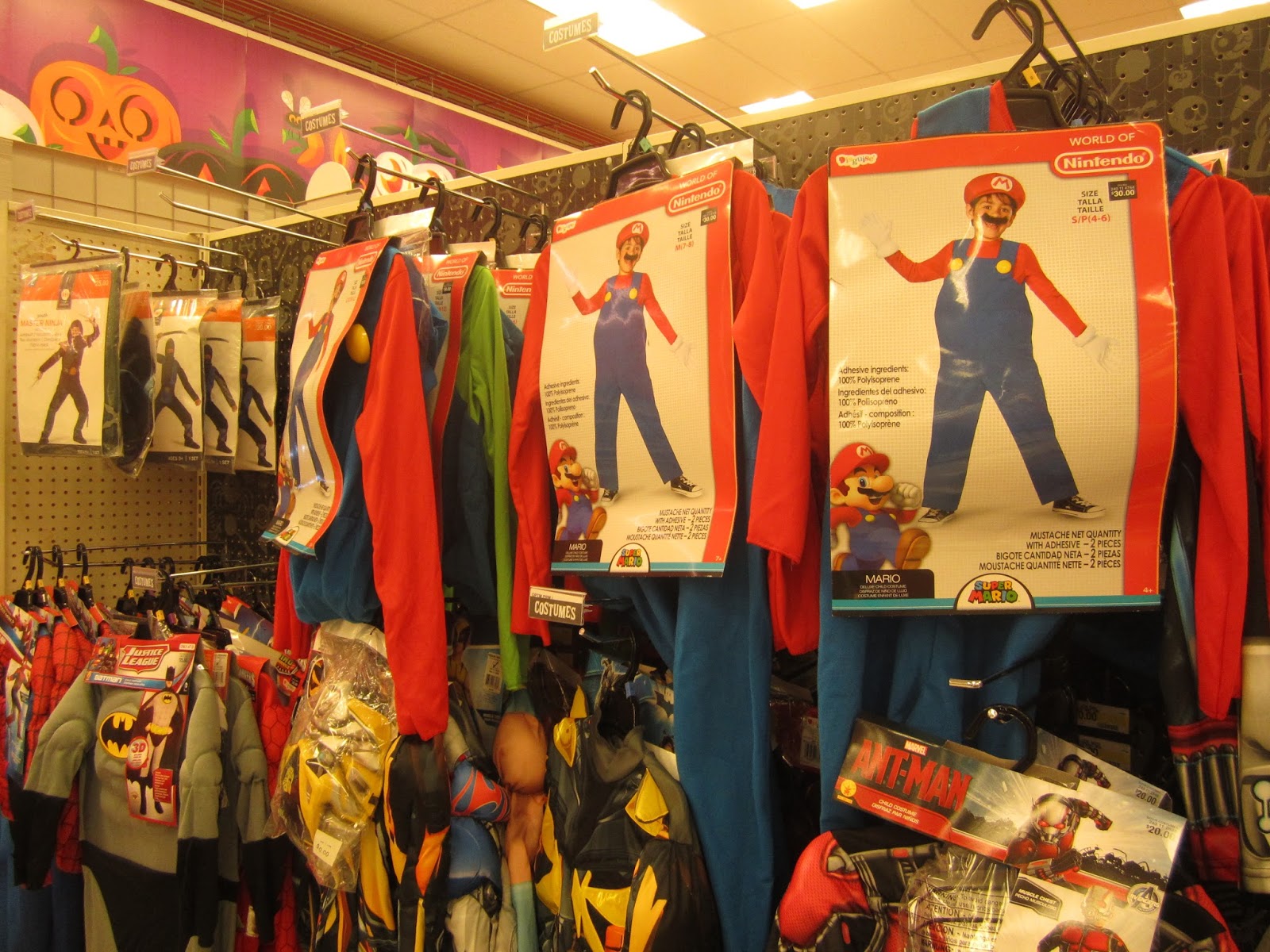
You want to dress like Super Mario, a hot dog (bless your heart) or Super Girl?  I can handle that!
And even though it drives me crazy from a dental hygiene perspective, I well remember the thrill of sifting through piles of delicious candy alongside my sister after an evening of trick-or-treating:
Not everyone's YES and NO areas are going to look the same; I can see that by looking around at the choices that my friends make during the Halloween season.  I don't think my choices need to dictate anyone else's, and I don't think anyone else's choices need to dictate mine.  But, as with so many things, I think there is room for fruitful conversation about our differences. 

***************************************

About Such Things

Julie at Happy Home Fairy offers a bit of advice when it comes to choosing a Halloween costume.  There are so many options out there; she advises following the principle found in Philippians 4:8: Is this costume choice right, pure, lovely, admirable, true, noble, excellent, and praiseworthy?  “The Bible tells us to think about these things, so I think it’s appropriate to apply our thoughts to our actions,” she writes.

Perhaps this is a worthy guiding principle for our approach to celebrating Halloween as a whole.
Found in Yahoo images; source not found
***************************************
For Further Reading

Here are some links to articles from Christianity Today that I think add to the conversation.  Keep in mind that the comments that come after the articles often provide new points of view as well:


Monday, October 19, 2015

Learning to Pray at Cana

Note:  I want to thank Nikki and Renee in my Women’s Bible Study group, and Christine in Living Stones, for their comments that provided the inspiration and direction for this post.
*************************************

In any discussion of prayer, we all come around to the fact that sometimes we simply don’t know what to say. 

A friend falls victim to cancer, and our prayers for comfort and encouragement feel weak and inadequate. A relative faces a difficult divorce, and our requests for guidance and well-being seem to miss the point of her need.  A natural disaster leaves us breathless from the misery left in its wake, and we have no words for the needs of the hundreds or thousands dead or displaced.

Even in our own lives—when we have an argument with our spouse that is weighing heavily on our hearts, or we feel unsure about handling a disciplinary issue with our children—we don’t know exactly what to ask God to do for us.  We don’t know the best thing to say to Him in the face of our circumstances.

Jesus’ first miracle—the changing of water into wine at the wedding in Cana—offers us a model for prayer in just these kinds of situations. 

When we talked about this passage in my Women’s Bible Study group at church, we laughed at some of the humor.  Remember in the story that Jesus goes to a wedding along with his mother and his disciples. Our Associate Pastor pointed out the passive-aggressive nature of Mary’s comment, “So, um, son…they ran out of wine.” And after Jesus’ response—essentially, “What has that got to do with ME?”—Mary turns to the servants and instructs them, “Do whatever he tells you.”  I picture there a great sigh coming from Jesus.  “MOTHER!” I can hear, in the tone of a frustrated son, perhaps used to being backed into the corner by his mom.

Let’s look at what Mary did NOT do before we consider what she DID.  She did not say to Jesus, “Son, they’re out of wine.  Go next door to the neighbor’s house and collect as much as they can spare.”  She did not say, “Just get a few more glasses filled; the party is over soon.” She did not say, “Just get them some cheap wine; they’re too drunk to know the difference anyway.”

Rather, she presented the problem to Jesus, and left it up to him to handle.  She knew the situation, that the reputation of the host was in jeopardy for his poor party-planning, but she did not presume to know what needed to be done. 

(I’m not sure we can fully appreciate the importance of the situation when matters of hospitality are not such sacred duties in our own place and time.  Running out of food or drink at a party might be a social embarrassment today, but would most likely not insinuate an insult to our guests, or result in the kind of social shame and disgrace that would be seen in Jesus’ time and place.)

Mary had confidence in her son’s ability to handle the situation—we don’t know if she foresaw him using natural or supernatural means—and she left the “answer” up to him. 

And by leaving it up to Jesus, Mary allows an even greater miracle to happen:  not just a little extra wine to get through to the end of the party, but wine in great quantities—six large stone jars full, each holding from 20 to 30 gallons, and filled to the brim.  And not just sub-par wine, but wine of great quality—so good that the master of the banquet praises the bridegroom for bringing out the best wine at the last, rather than getting everyone drunk on the good stuff first, and then replacing it with the cheap. 

Sometimes when we pray, we either think that we have the answer about what should be done, so we ask God to do it for us, or we feel some sort of uneasy obligation to come up with what to ask for, but we’re not really sure what the situation requires. 

What if we just went to God in faith and confidence, and told him our situation—the problem we are facing, the challenge that stumps us, the tragedy that overwhelms us, the circumstances we need help with?  And then what if we left things up to Him?  You know, the Creator and the Sustainer of the universe?  The one with the master plan?  The One who loves us more than we can ever fathom? 

What if, instead of trying to feed Him our solutions, we laid our concerns at His feet, and stepped out of the way to allow Him to work in our lives?

By leaving it up to Jesus, we allow even greater miracles than anything we could create for ourselves. We get God’s best, and in great abundance.

May we take notice of Mary’s confidence in Jesus when the crisis of hospitality occurs at Cana, and pray with the same confidence in our own situation.
Source
*************************************

“Which of you, if his son asks for bread, will give him a stone? 
Or if he asks for a fish, will give him a snake? 
If you, then, though you are evil, know how to give good gifts to your children, 
how much more will your Father in heaven give good gifts 
to those who ask him!” 
(Matthew 7:9-11)

Monday, October 12, 2015

Bringing an Underground Faith to Light


I recently read a negative Amazon review for a home-decorating book from a Christian publishing house. The reviewer felt that faith is a “personal thing” and shouldn’t be brought to bear (in the form of references to God and to the scriptures) on topics such as home decorating.  My first reaction was to think how sad it is that someone would feel that faith and religion should be hidden when discussing certain topics, and that she is so vehement about not wanting to bothered by someone else’s spiritual identity. 

But her comment took me back to a time in my life when I kept my own faith and spiritual life hidden.  I don’t know why I kept it so secret when I was a child, and later as a teenager.  No one suggested that it was something to hide.  It’s just that no one made it seem like something to talk about, so I didn’t. 

When I was eight-years-old, and we attended a Southern Baptist church for a few years, I would save the front page of the church bulletin, where religious quotations and brief lessons were printed. I would pick up brochures on display in the church narthex with titles like, “What is the sin that will not be forgiven?” Our southern newspaper had a religion section with commentary on scripture passages.  All these materials found their way into spirals and folders I kept in my room, which I took out to read from time to time.  No one ever saw those things; I kept my interest in matters of faith underground.

Later, as a teenager, I would put on my Walkman headphones, listening to AM radio sermons and taking notes.  I loved listening to sermons.  I harbored secret hopes of becoming a minister myself someday.  With no models of female ministers, though, I contented myself with the possibility of becoming a minister’s wife, and of enjoying a close connection with a church community that way.
 
My family knew none of these things, however.  Perhaps because I went to week-long Bible camps two summers in a row, though, my sister would refer to me as “the religious one in the family.” I was given the job of saying grace before Easter and Thanksgiving dinners—pretty much the only times we gathered for meals in the dining room.  My family probably figured it was easy for “the religious one,” but, in fact, I would hole up in my bedroom, tied up with anxiety, practicing what I might say. 

I tried briefly to get involved with a youth group at a Baptist church near my high school.  I had visions of a different kind of teenager there—teens who would look and act on the outside the way I felt on the inside.  Kids who wanted to be good and kind and holy, like I think I wanted to be.  It all came crashing down the night we played, ‘Honey, I love you, but I just won’t smile.’ It was a different era, so the game involved someone sitting on another person’s lap, trying to get them to crack a smile.  At one point, I had a boy on my lap trying to break through my resolve, and when I said, “Honey, I love you, but I just won’t smile,” he hit me.  I don’t remember now where he hit me, or if it was even hard or not.  I just know I was shocked, horrified, and done.  I never went back to youth group.  My faith went underground again.

I never revealed how important religion was to me.  I briefly tried a dorm Bible study during my freshman year of college, but the rest of my lifestyle didn’t fit a Bible-study persona, and I abandoned it pretty quickly.  I’m not a big one for regrets, but I do look back on my college years and wish that I had handled them differently—gotten involved at our campus chapel and brought my “hidden faith” to the forefront of my lifestyle.

When I lived in Center City Philadelphia with my first husband, I worked for a year at a small Christian school.  We had a required prayer meeting every day before classes began, and Wednesday morning chapel with the kids.  I could use Bible examples and verses as part of my instruction.  At home, we attended a Presbyterian church we walked to each week about seven blocks away. I became so “forward” with my faith that I even started bringing my Bible on our frequent flights to my husband’s home state, and read it like a novel on the airplane. 

Fast forward five years to the circumstances that led to our divorce.  I went through a phase of feeling like my faith, my hobbies, and my interests were mocked by my circumstances.  Here I was at home, rubber stamping greeting cards, reading my Bible, and planning home décor for my first house, and I felt like such a silly woman when I found out my husband had been cheating on me all throughout my “square” “homebody” pursuits.  I felt foolish.  My faith went underground yet again. 

It didn’t take me long to head back to church during my divorce recovery, though.  I found a large suburban Presbyterian church with a pastor who inspired and comforted me with his Sunday sermons.  Week after week I sat alone in the large sanctuary, and even put myself “out there” for a divorce-recovery group, a singles book club, and a cooking ministry in the church kitchen.  In spite of my involvements, I stayed largely anonymous in that church, but it was during this time that my faith and my identity as a church-goer and a “religious type” became non-negotiable for me.  I invited one of my boyfriends to church with me, and he snorted and said, “Why would I do that?”  That was one of the many incompatibilities that ended our relationship.  

But at that point I knew what I needed in a spouse:  in addition to being a man I could trust and respect, as my first husband was not, I needed a husband with a sense of humor and a faith in God—not just a superficial faith or a go-to-church-on-Sunday Christian identity, but a faith that translates into worship and service and honesty and love.  

When I met my husband Michael, I was able to recognize these qualities in him.  And as we have built our household and family together, my faith has never since gone underground.  It may be stretched, tested, and tried, but at this point I believe it has the substance to resist going underground again.

“You are the light of the world.  A city set on a hill cannot be hidden; nor does anyone light a lamp and put it under a basket, but on a lamp stand, and it gives light to all who are in the house.  Let your light shine before men in such a way that they may see your good works, and glorify your Father who is in heaven” (Matthew 5:14-16).


Related Posts Plugin for WordPress, Blogger...